
Most good businesses don't lose margin.
They give it away.
Margin Partners has documented the same four-discipline pattern across 70+ engagements in Australia and New Zealand, 500 written responses from owners who bought Take Back Your Margin!, and 750+ CEOs through Vistage and the CEO Institute. In every business, at least one of the four disciplines is absent or dysfunctional. In most, two or more. They don't travel alone. The cause isn't strategy. It's behaviour. And it's quietly costing the owner more than they realise. It doesn't have to be this way.
Two questions.
Every Margin Partners engagement begins in the leadership room with the same two questions on the table. Answer them honestly, before the rest of this page makes its case.
Are you rewarded for the value you create?
Are you respected for the value you create?
If the honest answer to either is no. The leak is real. It sits in one of four behavioural disciplines, and what follows is what most owners discover when they finally look.
Since 2017, Margin Partners has worked with 70+ businesses and organisations across Australia and New Zealand, reached 750+ CEOs through Vistage and CEO Institute workshops, and received written responses from 500 business leaders who ordered Take Back Your Margin! Each one was asked the same question: how will your clients seek to extract more value from your business over the next six months?
Three independent evidence streams. Over one thousand voices. One finding.
Most Australian and New Zealand businesses are not losing margin. They are giving it away. Through contracts that don't protect them, work beyond scope, value never priced, profitability never measured. Not a strategic failure. A behavioural one. Rooted in generosity. Unchecked, unpriced, and deeply cultural.
EBITDA operating margin is moving in one of two directions every day. Either it is leaking, or it is being protected and grown. Which way it moves is decided by the presence or absence of four behavioural disciplines.
Two views of the same pattern. Inside the engagement data, Contracting is absent or weak in 87% of businesses. Outside, in the voice of owners themselves, Over-Servicing is the visible symptom in 66% of responses. The team running too hard for too little reward is what owners feel. The contract that never said no is what is actually broken. The two are the same problem, viewed from different sides of the table.
The deeper finding. The Margin Recovery System reveals how these disciplines show up, or fall apart, in the day-to-day interactions between supplier staff and customer staff. The reluctant yes. The unspoken extra. The favour that never made it onto the invoice. Margin is given away in moments. The system makes those moments visible. A behavioural problem, rooted in culture. Self-respect, or its absence. Over-generosity. Fear. And because it is internal, it is fixable.
This is not theory. At 95% statistical confidence, ±3.1% margin of error. The same standard as national opinion research. The pattern is documented, repeatable, and industry-independent.
Four behavioural disciplines.
One pattern. Every business.
In every business, at least one of the four is dysfunctional. In most, two or more. They don't travel alone. Weak Contracting drives Over-Servicing. When the rules aren't written down, the team makes them up on the spot. Missing Measurement hides the cost of both. Under-developed Up-Selling means the value already delivered is never recovered. The four are a pack. They recover and grow as a system.
Sometimes the absence is deliberate. More often it is unconscious. Generosity that no one has been asked to protect. Blind spots no one has named. Either way, costly. Either way, fixable.
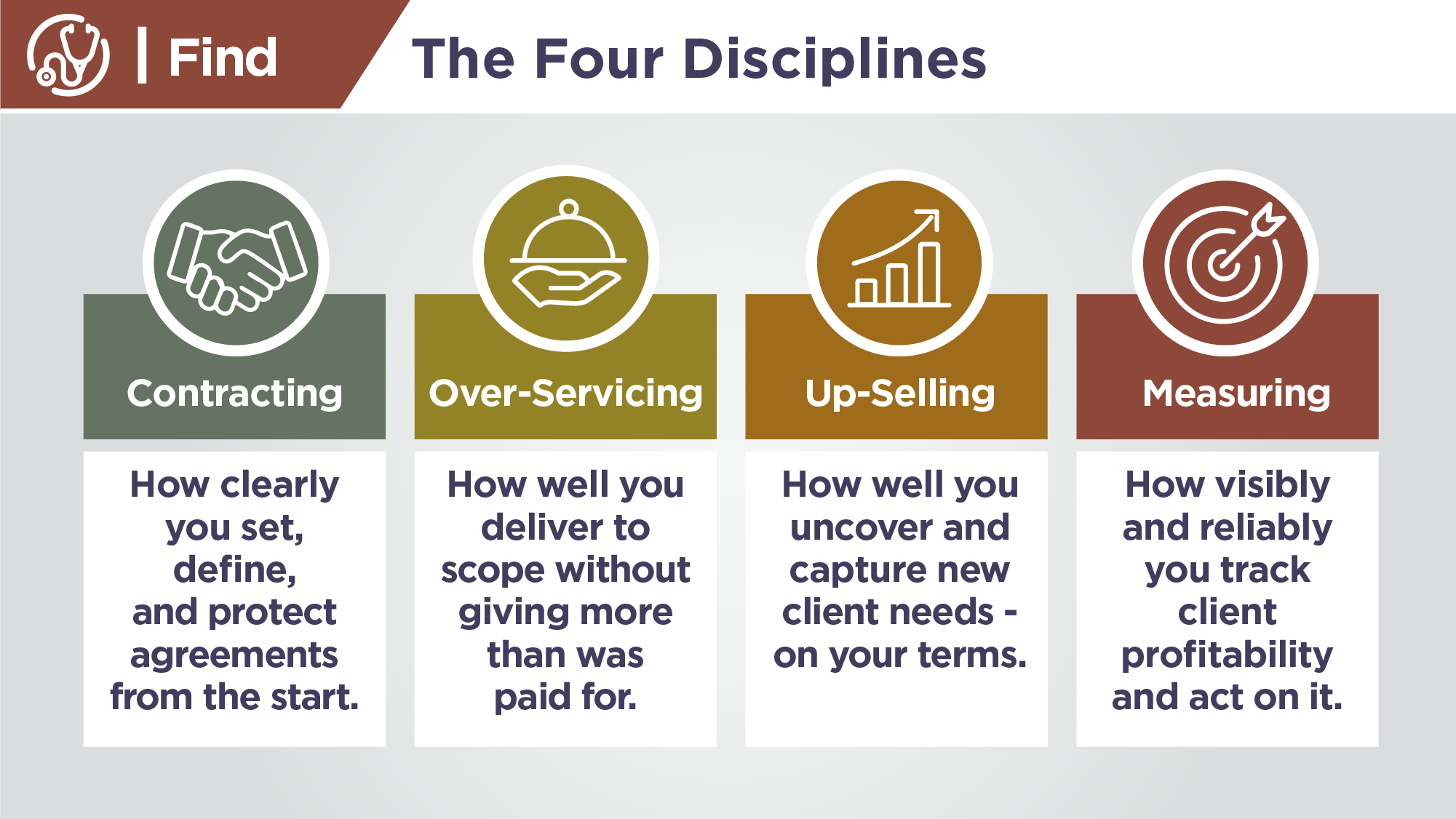
Contracting
The agreement nobody reads after the deal is done. Scope written in clauses that quietly favour the client. Variations the firm absorbs because pushing back feels small. The contract was the moment to set the terms. The moment passed.
Over-Servicing
The team delivers what was asked, then quietly delivers more. The weekend turnaround. The extra reports. The favour that became a routine. Nobody priced it. Nobody asked. Saying no felt unkind. The firm pays the difference, every week, in money it never sees.
Up-Selling
The owner sees a need the client hasn't named, and quietly meets it. New work that should have triggered a new conversation, a new agreement, a new line on the invoice. Generosity wins. The P&L doesn't.
Measuring
Revenue is tracked daily. Profit-per-client is tracked never. The owner knows which clients are loud and which are difficult. But not which ones are paying for the privilege of being there. What gets measured gets owned. What doesn't, drifts.
The owner is already feeling it.
Three quiet sentences the founder of a growing Australian or New Zealand business is rarely willing to say out loud. The patterns surface in every leadership room, scale-up to enterprise, every sector.
"I built this business. So why does another year of growth keep landing me in the same place. Busier, not richer?"
"If I get firmer with the clients we've carried for years, will they think less of me. Or of us?"
"If the business can't run profitably without me in every room, what exactly am I leaving behind?"
The honest line under all three: generosity was never the problem. The absence of disciplines to protect it was.
What leadership tolerates becomes culture.
What culture tolerates becomes margin lost.
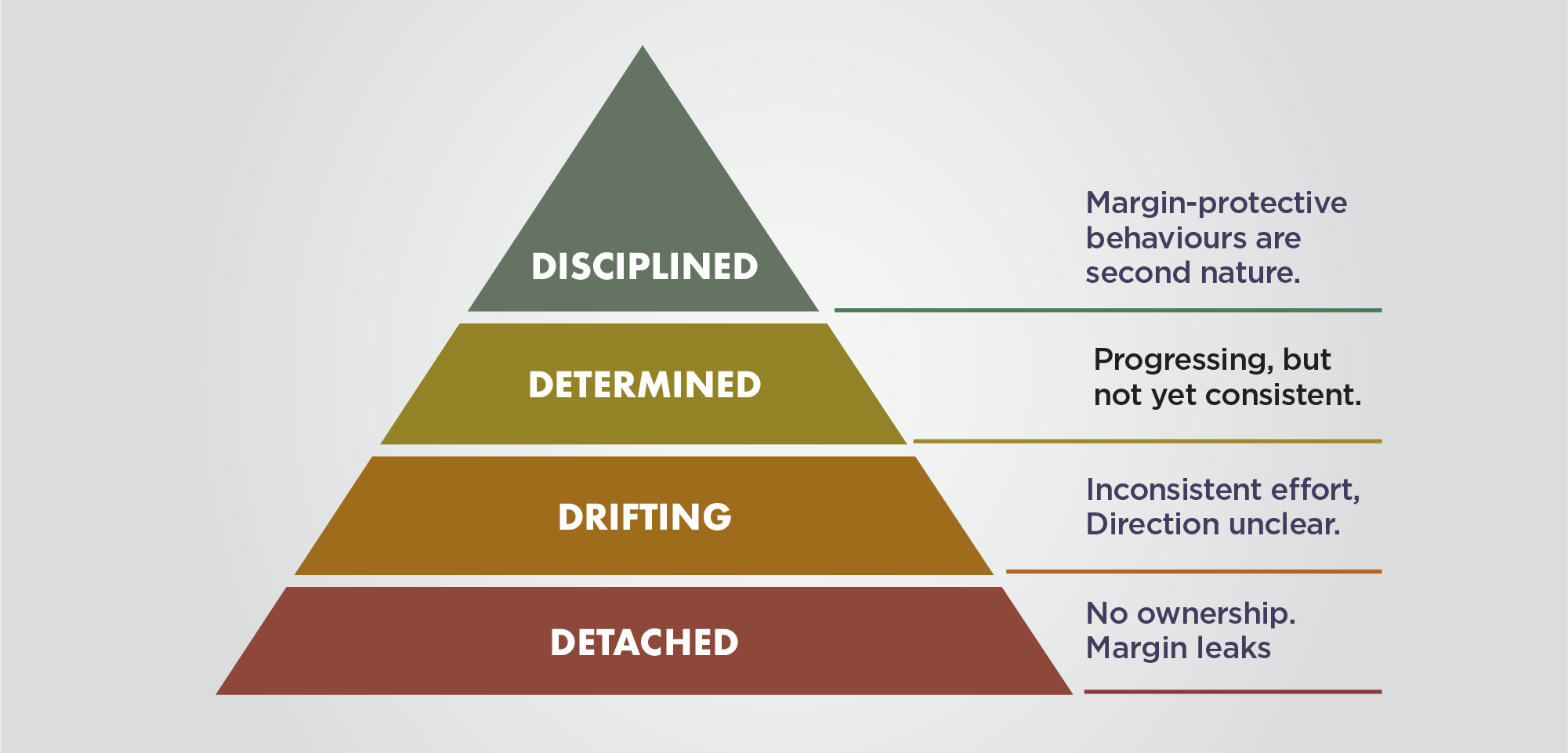
Too Generous to Thrive.
Becomes Too Generous. No More.
Generosity was never the problem. The absence of disciplines to protect it was. The leadership team that can see the pattern can fix the pattern. The dysfunction is internal. Which is exactly why it is fixable.
Margin isn't lost. It's taught.
See where the pattern shows up in your business.
Ten minutes. Twelve questions. The Margin Exposure Check ranks the four disciplines by exposure and names the leak to close first. Free. Confidential. No call, no pitch, no obligation.
